
- Home
- John Creasey
The Extortioners Page 12
The Extortioners Read online
Page 12
“Kind of?” asked Roger.
“Either blue jeans or grey jeans with the usual pockets, low-cut waistlines and contour fit.”
“You know,” said Roger, “we want a complete outfit for close examination and we want to find out where they are made.”
“Very good idea, sir!”
“We also want to find out where these are manufactured,” Roger went on, touching one of the concrete balls. “It would be easy enough with wooden or cast iron or plastic moulds.”
“Anywhere they make balls of that size for children,” Venables hazarded.
“Right! Toy-makers. So we need a list of toy-makers who might have moulds of that size,” Roger said. “And we want to find out if any of them have lost a mould or two recently.” He paused, looking intently at Venables. “What’s the name of the club these men are believed to belong to?”
“Known to belong to, sir – they had membership cards and the Hokki badge, an H in Japanese-type lettering. The London Central Hokki Motor Cycle Braves,” finished Venables, “and …” He broke off.
“Go on.”
“There are at least four other branches.”
“Where?”
“South West London, North London, South East and East – you might say sou’-south-east, sir.”
Roger said, softly: “Do the Divisions know all these?”
“Yes – and probably more.”
Roger picked up the cement ball, and tossed it a few inches into the air. Even as he caught it the impact was enough to sting. Hurled into a man’s face, or head, it could kill; if it was hurled against any part of the body it could break bones and cause a serious injury.
“I may be locking the stable door after the horse has bolted, but we want all of these clubs raided – tonight.”
Venables gulped. “Sir,” he muttered.
“You haven’t had them raided!” exclaimed Roger.
“No, sir, oh no, I wouldn’t do that without authority, but I have asked all Divisions to keep a close watch, and to question any members who leave the various club headquarters. So they’re all set to raid, sir – I think it would be a jolly good idea.”
Jolly good idea, Roger thought – it was like listening to Richard, years ago. He was still deliberating when he heard heavy footsteps in the passage; at any other time he would have thought: Coppell. The door burst open and Coppell strode in, massive in white tie and tails which fitted and suited him perfectly.
Roger stood up; Venables seemed glued to his chair. “Good evening—” began Roger.
“They told me you were dead!” roared Coppell.
“A near miss, sir,” Roger replied, and then motioned to Venables, who had at last reached his feet but looked as if he were about to collapse. “But only just. If Detective Sergeant Venables had not moved with exceptional speed and anticipation I think I would be dead.”
Coppell turned to Venables, who forced himself to stand to attention.
“I—ah. I only—ah—did the obvious thing, sir,” he stammered.
“It wouldn’t have been obvious to many people,” Roger remarked drily.
“Hmmph,” grunted Coppell. “Well, as you’re still in the land of the living you can tell me all about this.” His gaze roamed and he caught sight of the heading of Venables’s report and read it quite literally – “Battle of Bell Street. How many of the little bastards did we catch?”
Roger paused.
“F—five hurt, three charged and seven held,” Venables blurted.
“Talked to them yet?” Coppell made this question direct to Roger.
“No,” Roger answered, “and I’d rather try to pick up some more before starting to question them. There are some motorcycle clubs …” He explained briefly, with Coppell nodding after every sentence or so, and finished: “The Divisions are watching the club houses, and …” He paused, for Venables made a sound like ‘kkk’ as if he wanted to interrupt, but he thought better of it, and Roger went on: “I’d like to raid them, tonight.”
Coppell was still Coppell.
“All by yourself?” he demanded.
“I thought the Divisions might help, and we might use the Flying Squad from here, leaving a skeleton staff for emergency.”
“Do that,” Coppell approved, beginning to tum on his heel. “If you get any results which can’t wait until morning, send a message to me at the Mansion House – Lord Mayor’s Charity Banquet.”
“I will, sir.”
Coppell strode out, turned back with surprising agility for so big a man, and seemed to glower at Venables. And to Roger’s astonishment, he said: “None of us want to lose West. Look after him, Sergeant.” He was out of the office with the door swinging behind him before Venables began to turn from grey to white, white to pink, pink to purple. Roger sat at its desk and opened a file, and for the first time saw a diagram which Venables had drawn, showing the Metropolitan Police area in outline, and also showing the four places where the Hokki Motor Cycle Braves had clubs. One was in Fulham; one in Camberwell, one near Charlton and the fourth in Tottenham. He glanced at Venables, and said: “Go to your office and tell Fulham I hope to be there in half an hour. Meanwhile will they make all preparations for a raid and then tell Camberwell to make a raid – I’ll be there an hour later. You take the Divisions which cover Charlton and Tottenham – better do Tottenham first and Charlton immediately after, and you get to the second one as soon as you can. All clear?”
“Absolutely, sir!”
“Tell all Divisions they’ll have Flying Squad assistance, tell them to let none of the Braves leave until you or I have been there. I’ll give you a note of authority before you go. I’ll talk to Information and the Flying Squad. Get a move on, don’t stand gawping!”
Venables went out of the room like a frightened rabbit.
Roger was smiling as he picked up the telephone.
Forty minutes later, he was at the headquarters of the South West Division, talking to a Chief Inspector in charge. The club known as the Hokki Motor Cycle Braves was one of at least a dozen groups or clubs in the area. It – like the others – organised rallies, races, hill trials, cross-country runs. This particular club was well known because several of its members had been pulled in for pushing drugs, mostly L.S.D., but there was no evidence that all the members bought or were addicts. The Hokki Braves were mostly small youths and men, for the Hokki motorcycle was the smallest of the standard machines but with a powerful 500 c.c. engine. This could be supercharged until the machine had remarkable acceleration, as well as top speeds of well over one hundred and fifty miles on the open road.
“Do they behave themselves?” asked Roger.
“Now and again we pull one in for speeding,” said Hill, the man in charge. He was a tall, lean man with an almost completely bald head. “Their camp—”
“Camp?”
“They call it a camp, not a club,” said Hill, drily. “It’s on the Eelbrook Common. Do you know it?”
“I live in Chelsea,” Roger reminded him.
“Oh, yes. Well, they’re demolishing some houses facing the common and the Braves rent two or three of them – the last to be demolished – and use the houses as camp headquarters. They have plenty of parking space on the edge of the common and on the empty demolition sites.”
“How many are there now?” asked Roger.
“I’ve had the place under surveillance since the Battle of Bell Street,” Hill replied. “A few members have gone in, only one has come out and we held him for questioning. He hasn’t said a word yet.”
Roger had an uneasy feeling that the man would not talk.
“Let’s close in,” he said.
“Expect any resistance?” asked Hill.
“They might use iron piping, bicycle chains or these,” said Roger, holding out the cement ball. “Do you have riot shields here?”
“Yes.”
“Better have them handy,” Roger said.
Fifteen minutes after he had arrived, he went with Hill
in a car to the nearest spot to the houses which were used by the Hokki Braves. Light shone at the windows, and music from radio or record-player came clearly over the night air. Six or seven motorcycles stood on their rests, just outside. Roger, knowing it would be easy to make it look as if he wanted to hog all the limelight, stayed near while Hill and two of his men approached the front door. With Flying Squad men at least thirty police officers encircled the two small houses, once part of a long terrace at the Fulham Broadway end of the triangular-shaped common.
Hill banged on the door; there was no reply.
He banged again and called clearly: “Open, in the name of the law!”
There was still no reply, and Hill stood aside, ordering his men: “Break it down.”
The flimsy front door fell in on the third assault. Light streamed out, showing the branches of trees on the common, and the sound of music became much louder. Hill went in first, with his men close behind and others, including Roger, close on their heels.
The only sounds were the music and the thump of foot steps.
No one was in the house, but the seven records on a record-player indicated the men had been here only a short while ago.
“They must have had scouts out, seen us, and sneaked off without their motorcycles,” Hill said, bitterly. “My chaps were waiting to hear the cycles. Mr. West, I feel dreadful about this. Feel I’ve fallen right down on the job.”
“I’ve a nasty feeling all the others will have been fooled, too,” Roger said, glumly. “I shouldn’t blame yourself too much.”
“I do, all the same,” Hill said.
“Let’s have a look at the motorcycles,” Roger said. “If they’re the same as were used in Bell Street, the engines have been hotted up, and they’re tuned and doctored for speed and noise.”
“We’ll soon see,” said Hill.
The first machine, standing on its rest near the back door, had full tread on the rear tyre. Nothing indicated that it had been supercharged. A Flying Squad man spent five minutes taking the engine down, and announced:
“No one’s bored this one out, sir.”
None of the machines here was a ‘special’. Roger went inside where Hill and two of his men were searching for any sign of drugs. There was coffee, tea, milk, sugar, biscuits, nuts, even the ingredients for hot dogs and hamburgers as well as a variety of tinned food, but there were no drugs and no indication that any had ever been used.
“They couldn’t have cleaned the place up so thoroughly,” Hill argued. “If some of them are users and others pushers, they don’t operate here.”
“Doesn’t look like it,” Roger agreed. “I wonder what there’ll be at the other places.”
As they were heading for the Camberwell ‘camp’ word came through from there and also from Tottenham that the raids at each place had been abortive – obviously the Hokki Braves had anticipated them, and got away before the raid. The same proved true of the camp in Charlton. No drugs were found; no cement missiles, no supercharged motorcycles.
“They expected to be raided and they just cleared out,” Venables said, miserably. “I ought to have ordered the raids earlier, sir.”
“You stuck your neck out quite far enough,” Roger said. “They may have disappeared but they haven’t vanished from the face of the earth. And they may have a hide-out we haven’t discovered yet. Moreover, all the Braves may not be involved. Go home, get a good night’s sleep, and come in before nine in the morning. We’ve a heavy day in front of us.”
“Sir?” ventured Venables.
“Yes?”
“Shouldn’t we send out word for reports on all motorcycles seen in the streets tonight?”
“It wouldn’t do any harm,” Roger conceded, “but I think we’ll find that these chaps have gone to ground for a day or two. They’ll probably wait for our next move before they make theirs.”
“I think you’re still in very grave danger, sir,” Venables insisted. “I really don’t think you ought to go home or anywhere without an escort.”
Roger looked at him very steadily.
He was probably right; but seldom in his career had he been so scared that he had wanted protection. He did not want it now, everything in him reacted against it. Once he allowed himself to be forced into such a defensive position, once he admitted that it was not safe to walk about or drive alone, it would be a major concession to the other side, and that could not only improve their morale enormously, but it could weaken his … and, although they might not realise it, could affect many men at the Yard.
Slowly, he shook his head.
“Not yet,” he said. “The time might come, but not yet.” He dismissed the subject by squaring his shoulders and exclaimed: “Now! The Divisions will be getting all the information they can on these so-called camps. And first thing in the morning we want to start tracing all Hokki owners through the licensing departments in the various boroughs. We’ll charge them with breach of the peace then let all the prisoners stew for the night, I think. Before I go home, though, I want to check on Professor Clayton and Hubert Fellowes.”
Clayton was reported to be ‘a little better’.
Young Fellowes was still in the intensive care unit; the operation for brain damage was successful as far as the surgeons could judge, but there was an ever-present danger of a relapse.
All was quiet at the flat where Lady Fellowes and Helen were still together.
“So Helen didn’t go,” Roger mused aloud. “I thought it would take a lot to make her. I—but Sergeant!”
Venables started up. “Sir?”
“Young Kevin Spray! I’d forgotten him. Where is he?” “He’s in the waiting-room here, sir,” said Venables, and added guiltily: “I didn’t have time to mention him in my report. There’s a note about his mother, too. She telephoned twice this afternoon, wanting to know if there was any news of him. I didn’t tell her, of course.”
“I’ll go down and see him right away,” Roger said.
“Do you really think you should, sir?” asked Venables, in one of his curiously daring moods. “Wouldn’t it be better to leave them all until the morning? All the Hokki Braves, I mean.”
There was a long silence before Roger asked heavily: “Is Kevin Spray a Hokki Brave?”
“Oh yes, sir,” answered Venables. “That’s a thing I learned too late to put in my report. There’s a Hokki Braves camp in a lot of universities, including London. I sent a general request out to the police in all university cities for information and a great deal of it’s in. This organisation isn’t restricted to London, sir. It’s nationwide.”
Chapter Fifteen
Kevin Spray
Roger went down to the waiting-room by himself, still shaken by what Venables had told him. Was the sergeant right? Was the organisation which had leapt to action so quickly really nationwide? Were all clubs which called themselves the Hokki Motor Cycle Braves involved in crimes of violence?
“I simply don’t believe it,” Roger said aloud as he walked along a passage very similar to the one on his floor.
At the old Yard, prisoners had been kept handy at Cannon Row, the police station which was close by; there was no such facility in the New Scotland Yard, but some rooms on this floor had reinforced doors and windows, and two had reverse windows; one could see in from outside but not out from inside. The two rooms were virtually cells, and anyone under charge, and particularly anyone who might become violent, was invariably kept in one of them. Kevin Spray was in the first.
A policeman in uniform was just outside the door.
“How is he?” asked Roger.
“Asleep, as a matter of fact, sir. He got into a bit of a paddy an hour ago but after a bit of dinner he settled down and dropped off.” The constable unlocked the door and Roger went into the small but comfortable waiting-room. A plainclothes man sat in one corner armchair, newspaper by his side, a paperback book on his knees. Kevin Spray lay at full length on a couch which was amply long enough for him. His shoes were plac
ed neatly by the side of the couch, and his brown leather or plastic jacket was folded over another armchair. He wore a well-washed pair of jeans: the Hokki Braves’ uniform.
The plainclothes man, in middle years and corpulent, got to his feet.
“Shall I wake him, sir?”
“Leave him to me,” Roger said. “You take a breather.”
“Thank you, sir.”
“Tell the man outside to watch, in case I need some help.”
“Not much fear of that, Mr. West – but I’ll tell him.”
The man went out.
Kevin Spray showed no sign that he had been disturbed. He lay on his right side, facing the room, one arm over the top of his face, obviously to shade his eyes from the light. He breathed deeply and evenly. Roger moved close to him, vividly reminded of his own sons when they had been younger. He could not really see the youth’s face but the chin and mouth were very like Ida Spray’s. Gently, Roger began to move the protecting arm, then shifted his position so that his head cast a shadow over the top of the other’s head. Next he finished lowering the arm, so that it rested, still bent, on the flat stomach.
Roger studied the young face.
Kevin Spray, being fair, did not look as if he needed to shave regularly; ‘boyish’ was undoubtedly the word for him. But his forehead, jutting eyebrows and deep-set eyes, as well as his aquiline nose, were unmistakably his father’s. It was seldom that both parents were so clearly reflected in a face.
Boyish, Roger thought; and innocent. This was the deep, untroubled sleep of youth.
“Kevin,” Roger said, in a clear voice, but it had no effect. “Kevin!” He raised his voice, and the youth began to stir. He placed a hand on the other’s shoulder and gripped firmly. “Kevin – wake up.”
The stirring stopped, and he knew that the other was awake, and wary; but not watchful; after a momentary flicker, his eyelids did not move. In a quieter, less authoritative voice, Roger spoke again.
“Kevin, I am Chief Superintendent West, and I have a message from your mother.”
The youth’s eyes opened. They were a vivid blue, and very large. He did not move a muscle of his body, but stared intently at Roger, who sensed he was going to have problems; there was a stubborn set to Kevin Spray’s jaw and hardness in those blue eyes.
 Feathers for the Toff
 The Unfinished Portrait
 The Case of the Innocent Victims
 Love for the Baron
 Death of a Postman
 The Department of Death
 A Note From the Accused?
 If Anything Happens to Hester
 The Stolen Legacy
 The Doorway to Death
 Into the Trap
 Look Three Ways At Murder
 A Part for a Policeman
 The Terror Trap
 A Good Read
 The Legion of the Lost
 Sport For Inspector West
 Double for the Toff
 Nest-Egg for the Baron
 The League of Dark Men
 The Executioners
 Blood Red
 Last Laugh for the Baron
 The Toff and the Runaway Bride
 Model for the Toff
 The Warning
 Traitor's Doom
 The Arrogant Artist
 The Chinese Puzzle
 Darkness and Confusion
 Sabotage
 The Toff Breaks In
 Hunt the Toff
 Thunder in Europe (Department Z Book 6)
 The Extortioners
 Murder, London--Miami
 The Scene of the Crime
 Sport For The Baron
 Death in Cold Print
 Inspector West At Home iw-3
 Murder, London--Australia
 The Toff and The Lady t-15
 Give a Man a Gun
 Held At Bay
 The Man Who Stayed Alive
 Inspector West Takes Charge
 The Toff and the Fallen Angels
 Redhead (Department Z Book 2)
 Help From The Baron
 Alibi iw-39
 Go Away to Murder
 Attack and Defence
 The Baron Goes East
 Inspector West Regrets
 Gideon's Art
 Seven Days to Death
 Hammer the Toff
 Good and Justice
 Taking the Blame
 The Island of Peril (Department Z)
 The Toff and the Terrified Taxman
 Stars For The Toff
 The Toff and the Deep Blue Sea
 The Blood Diamond
 Go Away Death
 The Touch of Death
 Sport, Heat, & Scotland Yard
 Gideon's Fire
 John Creasey Box Set 1: First Came a Murder, Death Round the Corner, The Mark of the Crescent (Department Z)
 Send Superintendent West
 The Unbegotten
 The Baron Returns
 The Figure in the Dusk
 Triumph For Inspector West iw-7
 The Toff on The Farm t-39
 The Plague of Silence
 A Rope For the Baron
 Stars For The Toff t-51
 So Young, So Cold, So Fair
 Triumph For Inspector West
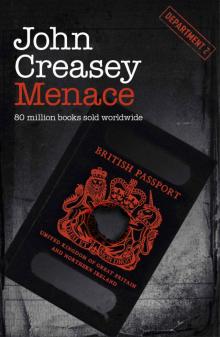 Menace (Department Z)
 Inspector West At Home
 The Toff In Town
 Murder: One, Two, Three
 Murder Must Wait (Department Z)
 The Toff In New York
 The Case Against Paul Raeburn
 An Uncivilised Election
 The Missing Old Masters
 Traitor's Doom (Dr. Palfrey)
 The Toff on Fire
 The Toff And The Stolen Tresses
 Meet The Baron tbs-1
 Gideon’s Sport g-1
 Shadow of Doom
 Accuse the Toff
 The Terror Trap (Department Z Book 7)
 Gideon's Day
 Dead or Alive (Department Z)
 Death Stands By (Department Z)
 Death by Night
 Gideon's River
 Call for the Baron
 The Toff And The Stolen Tresses t-38
 A Sharp Rise in Crime
 Murder, London--South Africa
 Death by Night (Department Z)
 Prepare for Action
 Strike for Death
 Poison For the Toff
 The Toff on The Farm
 The Toff and The Sleepy Cowboy
 Shadow of Doom (Dr. Palfrey)
 Thugs and Economies (Gideon of Scotland Yard)
 The House Of The Bears
 Criminal Imports
 Hang The Little Man
 The Toff And The Curate
 An Affair For the Baron
 Gideon's Night
 A Sword For the Baron
 Meet The Baron
 Kill The Toff
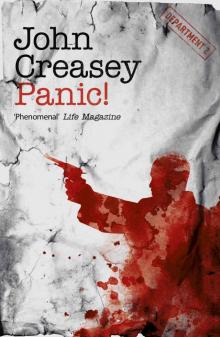 Panic! (Department Z)
 Inspector West Alone
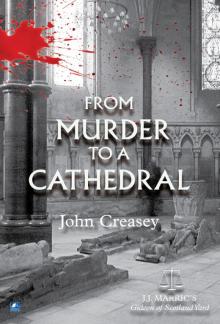 From Murder To A Cathedral
 Shadow The Baron
 The Toff and the Deadly Priest
 Introducing The Toff
 The Day of Disaster
 The Baron Again
 The Theft of Magna Carta
 The Toff and the Fallen Angels t-53
 Salute the Toff
 Murder, London-New York
 Vigilantes & Biscuits
 Inspector West Alone iw-9
 The Toff and the Great Illusion
 Battle for Inspector West
 Impartiality Against the Mob
 A Mask for the Toff
 Cry For the Baron
 The Depths
 A Case for the Baron
 The Toff at Camp
 Gideon Combats Influence
 The Toff and The Sleepy Cowboy t-57
 Carriers of Death (Department Z)
 Kill The Toff t-23
 A Backwards Jump
 Reward For the Baron
 The Smog
 Famine
 Send Superintendent West iw-7
 The Toff And The Curate t-12
 Hide the Baron
 The Masters of Bow Street
 An Apostle of Gloom
 The Death Miser (Department Z Book 1)
 The Insulators
 Not Hidden by the Fog
 No Relaxation At Scotland Yard
 A Conference For Assassins
 Gideon’s Sport
 The Flood
 The Black Spiders
 The Baron at Large
 The Mask of Sumi
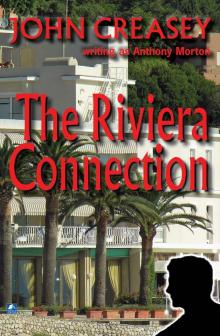 The Riviera Connection
 The Toff and The Lady
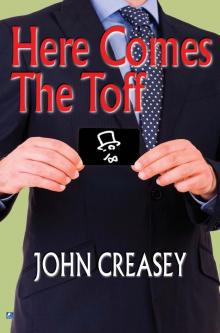 Here Comes the Toff
 The Toff and the Kidnapped Child
 Alibi for Inspector West